

Review: Oakland Ballet presents Dancing Moons Festival 2026: “Double Happiness Program”, April 30 – May 2, 2026, Great Star Theater, San Francisco, CA

As April rolls into May, Oakland Ballet Company (OCB) has touched down in the heart of San Francisco’s Chinatown for the fifth season of their groundbreaking Dancing Moon’s Festival. I first experienced this unique and rare showcase of Asian-American Pacific Islander artists in the world of ballet, in 2023 at the Oakland Asian Cultural Center, where the work was thrillingly presented in the intimate setting of a community room, with audience chairs arrayed around a dance floor. It is wonderful to see OCB continuing to expand their horizons. Dancing Moon’s Festival 2026 is comprised of two distinctly different programs over two weekends in San Francisco.
Making my way through San Francisco’s Chinatown, passing alleys topped with zig-zagging strands of glowing red paper lanterns, I approach the historic Great Star Theater, home of the first weekend’s program. A light-hearted repertory program titled “Double Happiness,” after OBC Artist-In-Residence and choreographer Phil Chan’s world premiere which comprises the second act, also includes engaging new work by choreographers Elaine Kudo and Wei Wang.
The evening opens on a strong and traditional note with Chan’s Amber Waves (2022), a romantic ballet duet performed with musical sensitivity and confident partnering by Jazmine Quezada and Alexander Griffith. With soaring lifts to match the crescendos of the piano composition, of Chinese American living composer Huang Ruo’s “Meditation on America the Beautiful,” the artists deliver an achingly beautiful portrait of a couple whose assured present yields to a poignantly uncertain future.
Kudo’s Opposites Distract transports us to the world of ballroom dance, where two couples’ changing allegiances and evolving romantic attractions favors us with sultry and sizzling couplings of fast-footed, skirt-swirling partner dancing. It is performed to recorded music by German guitarist Ottmar Liebert, whose flamenco guitar stylings are inflected with South American percussion, rock, jazz, and pop influences. Kudo’s movement vocabulary draws from the intricate rhythmic patterns and expressive arm movements of flamenco dance, the showmanship of competitive ballroom, and the long lines, ascending lifts and daring throws of ballet. The combination makes for some beguiling dancing from Pakela Newalu-Gomes, Ashley Thopiah, Alyssa Viray and, Phoenix Wilkins.
No one is credited with either lighting or costuming for Opposites Distract, and perhaps this explains the heavy-handed cueing that dumps the stage into near darkness periodically or finds one costume positively glowing in neon grandeur while others literally pale, due to a saturated blue lighting wash.
Featuring the strongest performances of the evening, choreographer Wang’s Child’s Play portrays an adult game of musical chairs. The five players, Katie Choi, Alexander Griffith, Mimi Lamar, Taiyo Makimura, and Devon Martirez y McFarland, are dressed in black suits with white shirts, suggesting collaborative professions as musicians or hospitality workers. Sharing a friendly rapport, they are amiable and playful, when there is room for all. They have a commanding boss, played with the simmering aggression and assertive psychological dominance by Eden Magana (the only performer in pointe shoes), who taps her wooden toe to issue commands. Appearing periodically to remove a chair and dismiss a contestant, her interference disrupts the unified ecosystem. Dancers pace, jeté, lunge, and feint in their efforts to retain a seat at the proverbial table while also attempting to appear aloof or fair-minded. As scarcity grows, chaos ensues and the participants become combative. Heightening the menacing tension onstage, Wang’s musical selections of “Rhyme of Taigu” by Zhou Long, with additional music by Davide Occhipinti. are pitch perfect.
Strutting en pointe, using the advantage of the extra height that affords, Magana asserts her superiority. As if saying “off with their heads,” she fan-kicks over the heads of her quaking minions. Balancing shared synchronized movement phrases with individual initiatives, Wang uses athletic ballet vocabulary to share ideas about the nature of competitive environments and the possibility of false scarcity. Metaphorically, I can see this work speaking to the nature of athletic teams, artistic ensembles, or even immigrant experiences within a land of abundance.

When I think of all OBC has on its plate to prepare for this program, as well as the reprise of their monumental work Angel Island (2025) at the Herbst Theatre within the week, it is no surprise that Chan’s Double Happiness feels under-resourced. An ambitious 25-minute piece for the full company, it is inspired by the musical world of the Shanghai songbirds, who in the 1920’s & 30’s gained popularity for their unique blend of Western jazz and traditional Chinese music.
Chan and company haven’t had sufficient time to develop the unique characterizations for which they strive. Outfitted in modern-day form-fitting modern rehearsal clothes, each person sports their own vibrant hue. The odd hairband, bowtie, or thick-rimmed eyeglass accessory does little to assist with the development of the campy personas. Personally, I would set the action in the 30’s with well-designed period costumes and lean into ballet more.
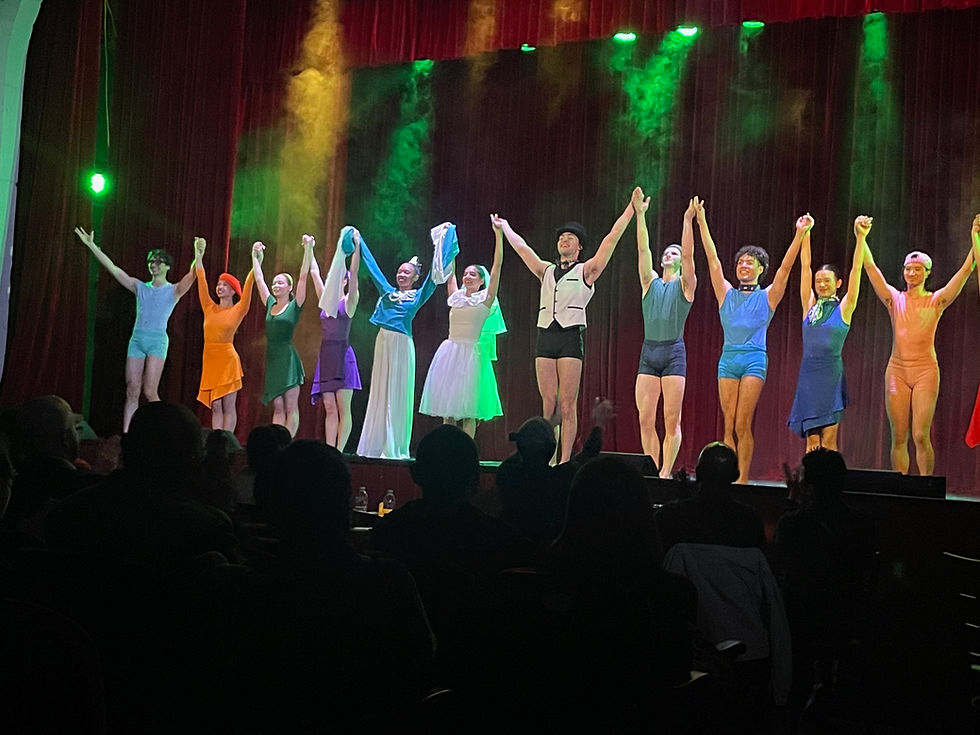
There is a stand-out trio for Alyssa Viray, Alexander Griffith and Phoenix Wilkins. Ashley Thopiah, as the girlfriend and eventual Bride, to Wilkins’s Groom, is buoyant and attractive throughout. The ensemble numbers, which draw from tropes of the Hollywood jazz musicals of the likes of Jack Cole and Gwen Verdon, have potential. A dancing in the rain scene with projected raindrops decorating the proscenium arch, and a rainbow wall of spinning umbrella tops from which dancers peek, has charm.
I felt for Eden Magana, cast as the Goddess. Her role, as the guide of the other dancers, was too similar to her assignment as the boss in Child’s Play. It is a disservice to her and to the tradition of Chinese ribbon dance, to dress her in a costume, whose flowing body-length silk sleeves require years of training in order to ably deploy them in a graceful flow, and ask her to do her best. It is a credit to her as a performer that she retains her confidence under these trying circumstances. Double Happiness deserves another showing when more studio time and professional design resources could help Chan’s excellent idea reach its full potential.
Next weekend, May 8 & 9, promises to be special. I had the privilege of seeing OBC’s evocative interpretation of Ruo’s 90-minute oratorio Angel Island, when it premiered last May at the Paramount Theater in Oakland. In these times of political turmoil and renewed anti-immigrant vitriol, detention and removal, the relevancy and necessity of this artistic intervention is essential. The OCB production speaks to all our senses, ensuring audiences truly grasp the hopes, fears, and anguish of the many Chinese immigrants detained at the Angel Island Immigration Station from 1910-1940. With movement crafted by seven different choreographers, embodied by the dozen members of Oakland Ballet’s company, and supported with evocative stage craft, Angel Island is immersive and inspiring. The stupendous live musical accompaniment by the Del Sol Quartet and members of the Volti choral ensemble enriches the experience all the more, which is a long way of saying weekend two at the Herbst is a must-see!
Review by Jennifer Norris, published May 3, 2026.
__________________
OAKLAND BALLET PRESENTS THE FIFTH ANNUAL
DANCING MOONS FESTIVAL
April 30 - May 2
Great Star Theater, San Francisco
May 8 - 9
Herbst Theatre, San Francisco
Amber Waves
Choreographer: Phil Chan
Music: Meditation on America the Beautiful by Huang Ruo. By arrangement with Boosey Hawkes, Inc., Agent in the U.S., Canada and Mexico for G. Ricordi and Co. (London) Ltd./Universal Music Publishing Group, publisher and copyright owner.
Costumes: Kaori Higashiyama
Dancers: Jazmine Quezada, Alexander Griffith
Opposites Distract
Choreographer: Elaine Kudo
Music: Ottmar Liebert
Dancers: Pakela Newalu-Gomes, Ashley Thopiah, Alyssa Viray, Phoenix Wilkins
Child’s Play
Choreographer: Wei Wang
Music: Rhyme of Taigu by Zhou Long By arrangement with Boosey and Hawkes, Inc., o/b/o Oxford University Press, publisher and copyright owner. Additional music by Davide Occhipinti.
Dancers:
Boss: Eden Magana
Players: Katie Choi, Alexander Griffith, Mimi Lamar, Taiyo Makimura, Devon Martirez y McFarlan
Double Happiness
Choreographer: Phil Chan
Music: Diane Lampert & John Gluck Jr., Alvaro Carillo, Manuel Esperson Gonzalez, Tony Hatch, Cole Porter & Celso Carrillo, Perez Prado. Performed by Chang Loo, Rebecca Pan, Ling Kong, Mona Fong, Chiang Ling
Costumes: Kaori Higashiyama
Dancers: Goddess: Eden Magana Bride & Groom: Ashley Thopiah, Phoenix Wilkins Full Company


Comments